Last winter we did a test in a house in Kamnik. Two identical rooms, both 14 square meters. Outside minus 4. Room A: aluminum radiator under window, water 55 degrees, air set to 22. Room B: one 700W infrared panel on ceiling, air set to 20. We heated both for 2 hours. Then we opened all windows for 10 minutes, closed them, and measured. Room A dropped from 22 to 12 degrees in 4 minutes. Walls were still 14 degrees cold. It took 58 minutes to get back to 22. Boiler ran non stop.
Room B dropped from 20 to 15 degrees in 10 minutes. Walls were 22 degrees warm. After we closed windows, air was back to 20 in 3 minutes. Boiler does not exist. Panel was off the whole time, walls did the reheating. That is the difference between storing heat in air and storing heat in bricks.
Air Forgets, Bricks Remember
Your radiator stores heat in air. Air weighs almost nothing. One cubic meter stores 0.34 Wh. You open a window, you throw it away. You close the window, you have to buy new heat.
An infrared ceiling panel stores heat in your house itself. Your floor, your walls, your sofa, your bed. One cubic meter of brick stores 500 Wh, almost 1500 times more than air. You already own 100 cubic meters of that storage, for free.
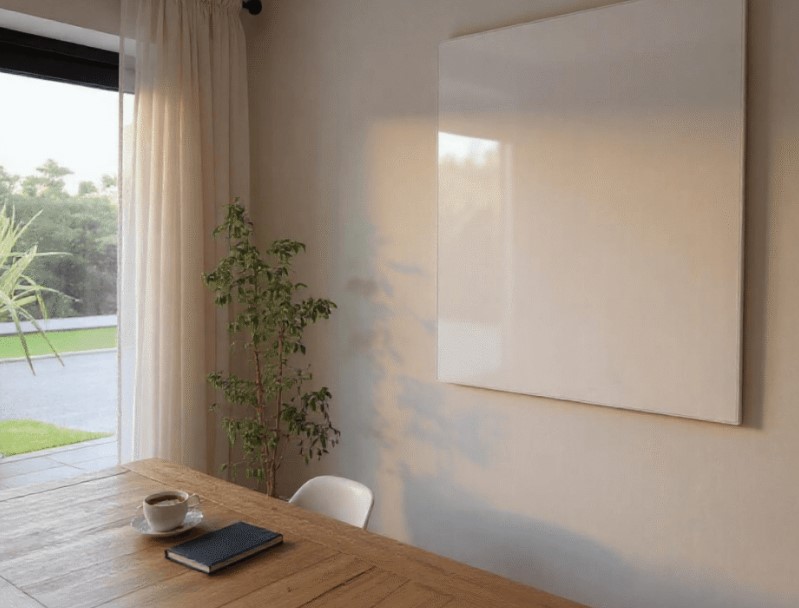
The panel is 2 cm thin, 60×120 cm, 7 kilos, 4 screws, one cable. No water, no pipes, no boiler. It shines invisible infrared light, like sun through a window in February that warms your face even when air is minus 5. That light does not heat air, it crosses it and becomes heat only when it hits something solid.
You feel it on skin in 60 seconds, like sitting by a fireplace. In 15 minutes your floor is 23 degrees warm barefoot. In 30 minutes your outside wall is 22 degrees warm to touch. Now every surface around you radiates warmth back to you like a warm tile stove. Your body stops losing its own heat to cold walls. You feel warm at 20 degrees air. With radiators you needed 24 to feel same.
The Three Things Radiators Do That Make You Sick
First, they move air. Cold to radiator, hot to ceiling, cold down along outside wall. That loop lifts dust from floor, burns it on 60 degree metal, that is that dry winter smell, and throws it into your lungs. Humidity drops to 30 percent. Throat scratches, eyes itch.
Second, they keep walls cold. Outside wall stays 14 degrees all winter. Warm humid air from shower, cooking, breathing touches that cold wall and drops water, like cold beer bottle sweating. Wall is wet 24 hours a day. Mold lives on that wet film. You bleach it, it comes back, because wall stays cold.
Third, they have one brain for whole house. You must heat everything or nothing. Guest room heated for 3 months for nobody. Gas fixed fee 12 euros a month even when you do not heat, boiler service 150 euros every year, chimney, risk of gas leak.
Infrared has none of that. No air movement, no draft, no dust flying, humidity stays at healthy 50 percent. Walls are 21 degrees warm, so 24 degree humid air cannot leave water on them. Physically impossible to condense on warmer surface. In 90 percent of houses black mold behind wardrobes dries out by itself in 3 weeks, no chemicals. And each room is its own house.
One Room Is One House
One panel, one WiFi thermostat with small sensor you put on desk where you sit, one app. Living room 21 from 17 to 23 only. Bedroom 19 for sleep, 22 for 20 minutes before alarm so floor warm when you step barefoot. Kids room 21 from 14 to 20. Office weekdays only. Guest room 15.5 all winter anti mold for 6 cents a day. Weekend house has no water inside, nothing can freeze and burst. Leave at minus 15 for 3 months completely off. One hour before arrival tap ON on phone, arrive to warm floors and bathroom mirror that never fogs because glass is warm.
It pulses 20 minutes on, 40 minutes off because warm walls keep heating when off. Effective 2.5 hours per day, 1.75 kWh per day per room, 0.44 euro per day per room, whole winter per room about 79 euros. Silent, maintenance free, 25 year warranty. White, black glass, mirror that never fogs, or your family photo printed on it that heats living room.
We spent 100 years heating air we throw out the window. Time to heat bricks that stay.